| |
|
I made
the mistake of going to see the Takashi
Murakami show on Black Friday,
the big shopping day after Thanksgiving. I had to get in line
at 2:30AM for the doors to open at sunrise 6. The convivial queue stretched
from the Geffen MOCA all the way to the Grand Avenue MOCA. During the
dark and cold wait, curators and docents were passing out coffee, scones
and discount coupons for a holiday handbag and a DOB-bie keychain.
Director Jeremy Strick was there, reassuring the crowd that no Louis
Vuitton store revenue enriched the museum—they only paid for
the opening party! A strolling Christmas choir, festive in Dickens
attire, sang carols, a rap version of ‘Nearer My God To Thee’ and
a few Hanukkah favorites. All the security guards wore riot gear. The
art loving shoppers were civil and well mannered until management opened
for business. The crowd surged and choked the door. Elbows flew and
eyes were blackened. It looked like a high fashion mosh pit. A woman
screamed. A dapper gentleman in a smart Burberry suit unearthed a small
palm tree and hurled it through one of the plate glass doors. All hell
broke loose...
The battle of art versus commerce is as old as a cave painting with
no resolution in sight. Like warring twins, art and commerce really
can’t live without each other. In “Pecker”, John
Waters’ art world treatise, Mr.
Bozak, the deli owner and ersatz
photo show gallerist, threatens with a spatula and shouts, “You
just can’t look at the pictures without buying something!”
A brand is a matter of definition, identification and meaning. The
future of the brand looks to encompass lifestyle, spirituality and
sociology. Branding has become a new medium.
We live in a branded culture. A brand is a relatively new concept that
is continually evolving with depth and intention. (It’s the cross-branding
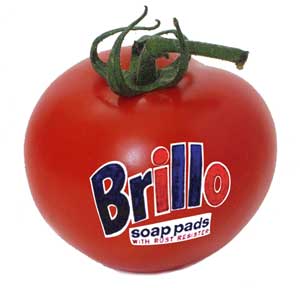
that will kill us. When we buy the Mercedes Benz Hothouse Tomato for
it’s sleek styling, we’ll be in trouble.)
Much has been written and little said in the press about the Japanese
Warhol-Hasbro. Murakami is now a brand, but he did not start out that
way.
Throughout time, artists have lent a brush stroke to jazz up commerce.
Salvador Dali played with fashion, painter Richard
Prince now has his
own handbag and Damien
Hirst is spinning it for Levi Strauss. It is
novel entertainment.
As an artist, Murakami simply re-colored the Louis
Vuitton bag. With
a white background to counter the long established brown, the result
was noticeable and wildly popular. Demand was high. Almost instantly,
counterfeit knockoffs could be found in the swap meets of Rome and
the streets of Tijuana. Vuitton wanted more and Murakami was able to
interject his own design language into the Vuitton motif. This is when
Murakami slipped away from the distinction of artist-designer and moored
himself as a brand.
Logos are potent symbols and they can be very artful. If you put a
Nazi swastika on the cover of a book, expect sales to jump upwards
of fourteen percent. The swastika, originally the svasti, a Neolithic-era
tag, is a Jainist, Hindu and Buddhist symbol that is perfect in its
beauty and symmetry. It used to translate as ‘conductive to well-being’ but
it’s off limits now. Leave it to a fascist to take the fun out
of everything.
For the urban hipster, Shep Fairey’s OBEY is as ubiquitous as
the Golden Arches.
As a waterdog scion of Newport
Beach, I named my first sailboat ‘Kahlua’.
It may seem a rather jaded choice for a nine year old, but I have always
been enamored with the sensual coffee liqueur logo. To this day, I
look at the distinctive type with rattan highlights and I go glossy-eyed
with slipstreams of warm sandy beaches, grass skirts and the come-on
of an exotic come-hither.
A brand logo offers the implication of a quality. The MAGlite flashlight
is reputed as the finest made. I believe you’re in good hands
with Allstate. Thunderbird is the choice of every skid row sommelier.
Brands, giving distinction and implying quality, are elitist by nature.
I can’t remember which is more impressive, a Harvard tie or Yale neckwear? I know that both carry more weight than Caprice County Trade
Tech, my alma mater.
Where do you coffee? Starbucks or Coffee Bean? In LA, the difference
is between a waitress job and a sitcom role.
If clothes make the man, then the brand makes the clothes.
The goal of a brand is to extend its value. It’s about financial
maturity, market penetration and revenue extrapolation. In short, it’s
about making more money. If we sell the popular Happy-X Widget, then
why not market the Happy-Y Widget. Why not Happy-Z?
There is no better example than the tie maker from the Bronx. Ralph
Lauren extended his fashion brand to furnishings and eventually house
paint. The rugged, outdoor, fresh air brand of Eddie
Bauer could upscale
a Ford Explorer. But can Montblanc, the pen makers, extend themselves
to jewelry? I doubt it.
This is the difference between extension and exploitation. Damien Hirst
exploits his value with Levi Strauss while Warhol was able to extend
his to stationery and greeting cards.
Distinction is the hallmark to a brand. Warhol’s painting style
became a brand while Jeff Koons’ or Richard Prince’s will
not. Murakami, with his repetitive elements, is becoming one. Brands
are recognizable.
Today, as a brand tries to extend itself, the evolution aims for the
psychological well-being. I was waiting for a coffee at Starbucks and
several of their new products told me to ‘create’ and to ‘dream.’ An
art professor, a probation officer or a psychiatrist can tell me that
but not a goddamn coffeemaker.
The GAP has built a specialized product line and a campaign around
African AIDS awareness. Is this an extension or an exploitation?
Fairey’s pervasive OBEY logo is laden with the import of great
meaning yet it remains without. The street work is designed to remind
us that symbols can have great meaning. Or not. There is some value
in the message, as well as an opportunity lost.
Branding is evolving from a simple product distinction to a sociological
mirror of our culture. A brand (or a logo that we wear on our shirtsleeve)
is our distinction and our identity.
My latest work, the Fellowship of Fortuna, is in the school of Phenomenology.
If America’s fastest-growing art-centric religion is to be part
of our culture, then branding is a necessary new tool. How else can
I end world war by proving that religious affiliation is no more important
than the label in your collar? Branding is a medium for the artist.
|
|
|